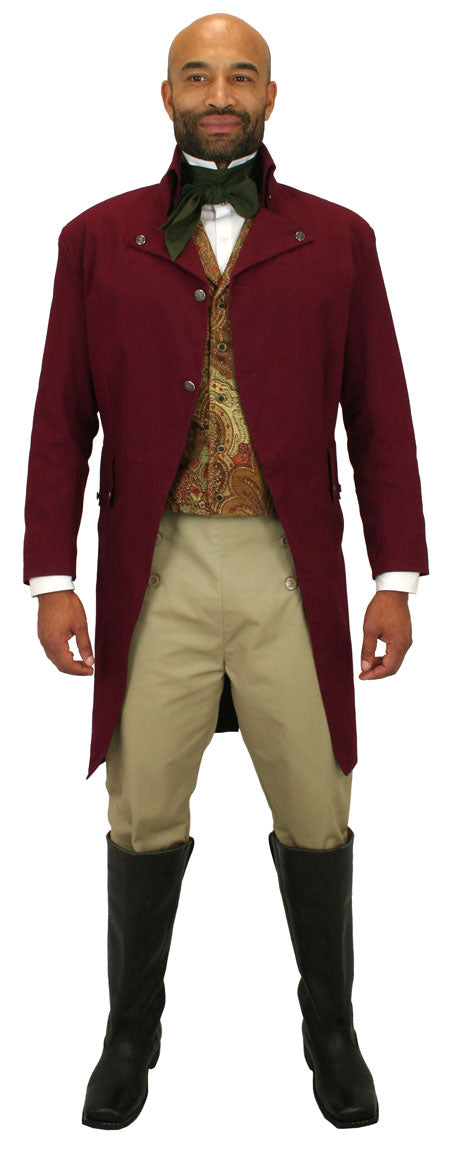
Men's Vintage Style Coats

A 19th Century gentleman never left home without a coat, and picking a coat to suit the occasion was (and is) a must. Formal events called for tail coats, cutaway coats, and morning coats, while everyday styles like frock coats, sack coats, and town coats would be worn on the way to the bank or market, with a cozy smoking jacket waiting in the parlor at home.

Bad weather called for overcoats, Norfolk Jackets and inverness capes, and frontiersmen counted on their dusters to keep nature at bay.

We are delighted to offer this wide selection of vintage style coats, and invite you to visit our outfits page to see them in complete ensembles. Also: although antique in style, these timeless fashions feel right at home as part of your modern wardrobe as well!

Please contact us if you have any additional questions.

Men's Vintage Style Coats
Filter

Filter

79 products

Availability
Product type
Color
  • Black (29 products)
  • White (2 products)
  • Beige (5 products)
  • Brown (16 products)
  • Red (12 products)
  • Blue (1 products)
  • Navy (2 products)
  • Gray (10 products)
  • Green (4 products)
  • Purple (1 products)
  • Multicolor (2 products)
Size
Materials
Pattern
Price

The highest price is $249.95

$
$
Sleeve length type
Decade
Care instructions

Q&A About Men's Vintage Style Coats

Victorian men wore a variety of coats including frock coats, morning coats, lounge coats, dress coats (tailcoats), Chesterfield overcoats, Inverness capes, and Ulster coats. Each coat style had specific social contexts and purposes, with formal styles like the frock coat for business and tailcoats for evening events, while overcoats provided protection from elements.

Victorian men's coats had specific names including frock coats (formal daywear), morning coats (formal daytime events), dress coats or tailcoats (evening formal wear), and various overcoats such as the Chesterfield, Inverness, and Ulster. The precise terminology reflected the strict social stratification and dress codes of Victorian society.

Victorian men wore heavy wool overcoats in winter, with popular styles including the Chesterfield (a knee-length coat often with velvet collar), the Ulster (a long, heavy overcoat with cape), and the Inverness (featuring a cape instead of sleeves). Wealthier gentlemen might add fur linings, scarves, and top hats with ear flaps for additional warmth.

Victorian men did wear tailcoats, known then as "dress coats," which were required evening formal wear for dinner parties, balls, the opera, and other formal nighttime events. The tailcoat was considered the highest form of formal evening attire throughout the Victorian period and represented proper gentlemanly dress for formal occasions after 6 PM.

Victorian cape coats were known by several names, with the most common being the Inverness coat (featuring a full-length attached cape over the shoulders instead of sleeves) and the Ulster coat (which included a detachable cape). For evening wear, the opera cape or cloak provided a dramatic silhouette for formal occasions.

Men wore formal evening dress to Regency balls, consisting of a dark tailcoat with contrasting breeches or pantaloons, waistcoat, white or black cravat or stock, and dress shoes or boots. This formal attire, the precursor to Victorian evening wear, emphasized a slim silhouette with padded shoulders and a nipped waist to create the fashionable masculine figure.

The difference between a morning coat and a tailcoat lies in their design and purpose: a morning coat (cutaway) was formal daywear with a gradually sloped cutaway front and single set of tails, while a tailcoat featured a horizontal cut at the waist with two distinct tails and was strictly evening formal wear. Morning coats were typically black or gray for formal occasions; tailcoats were always black for evening events.

Victorians wore their most formal attire to balls, with men donning black tailcoats ("dress coats"), white waistcoats, white bow ties, and black formal trousers with silk stripes down the sides. This white tie ensemble was considered mandatory for proper gentlemen attending balls, while ladies wore elaborate evening gowns with appropriate jewelry and accessories.

A lounge suit, the predecessor to the modern business suit, consisted of a matching jacket and trousers typically in dark colors, worn with a waistcoat and tie. Emerging in the late Victorian era as less formal than <a href="/store/mens-coats.php?type=Frock Coats">frock coats</a>, lounge suits featured a shorter jacket with notched lapels, offering greater comfort and practicality for everyday professional wear.

You should not wear a tailcoat with black tie attire, as tailcoats are strictly for white tie occasions. The proper black tie attire requires a dinner jacket (tuxedo), while tailcoats are reserved exclusively for the more formal white tie dress code, and mixing these distinct dress codes would be considered a significant formal wear violation.

A Newmarket coat is a Victorian gentleman's riding coat characterized by a closely fitted body, flared skirt reaching to the knee, and often featuring a contrasting collar. Named after the famous British horse racing venue, these coats were specifically designed for equestrian pursuits and became popular among the hunting and sporting set.

To determine your vintage coat size, measure your chest at its fullest point with a tape measure held parallel to the floor, then add 4-8 inches depending on desired fit and how many layers you plan to wear underneath. For historical accuracy in Victorian-style coats, consider that period garments were often tailored closer to the body, so additional measurements including shoulder width, sleeve length, and torso length are essential.

Common mistakes in chest measurement include measuring over bulky clothing, holding the tape measure too tightly or too loosely, not keeping it parallel to the floor, and failing to stand in a natural posture. For vintage coat fitting, it's particularly important to consider that historical sizing differs from modern standards, with Victorian men's coats typically featuring narrower shoulders and more shaped waists than contemporary counterparts.

A cutaway coat is a formal men's garment characterized by a front that slopes back from the waist button to form tails at the rear. This distinctive style features a horizontal cut across the front waist with the coat "cut away" to reveal the waistcoat and trousers, making it appropriate for formal daytime events in Victorian society.

A frock coat was the standard formal business attire for Victorian gentlemen, featuring a knee-length skirt all around (unlike the cutaway morning coat) and usually made in black or dark colors. This conservative garment symbolized respectability and professionalism throughout most of the 19th century before gradually being replaced by the less formal lounge suit by the early 1900s.

An Ulster coat was a heavy, long overcoat often featuring a cape and belt, designed for maximum protection in harsh weather, while a Chesterfield was a more streamlined, knee-length overcoat frequently featuring a velvet collar and no cape. The Ulster represented practical outerwear for country and travel, while the Chesterfield served as a more refined city coat for professional gentlemen.

Your Recently Viewed Items